
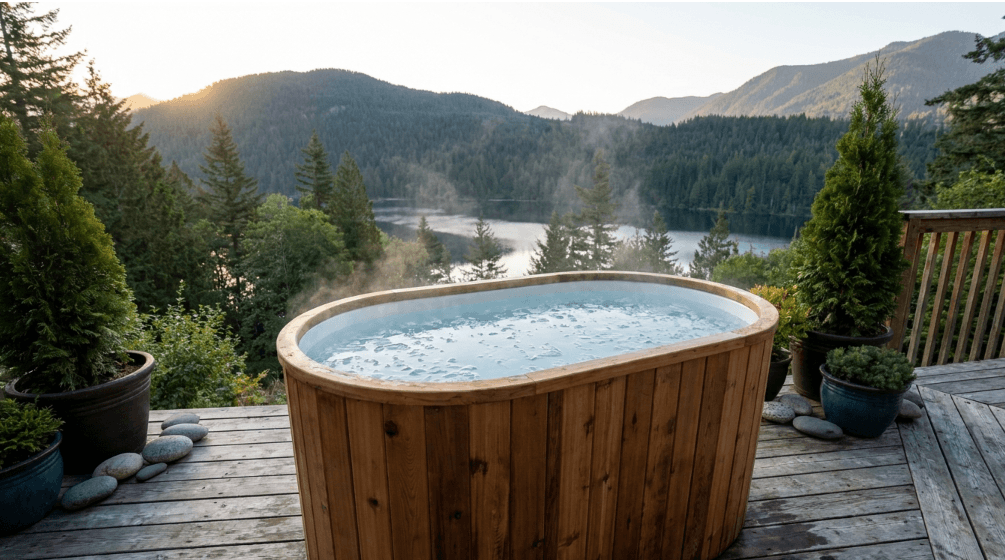
What a Cold Plunge Really Costs, From Unit to Install

A home cold plunge realistically costs $3,500 to $10,000 all in once the tub, chiller, filtration, electrical work, and placement are added together, not just the $2,000 to $3,000 sticker price often advertised for the tub alone. Four cost categories drive that total: the unit itself, electrical work for the chiller circuit, site preparation and drainage, and ongoing monthly costs for power and water treatment. Breaking the budget into these four pieces before shopping keeps the final number from becoming a surprise.
1. The Tub and Chiller Unit
This is the number most listings lead with, and it typically ranges from $2,000 for a compact ambient or ice-based tub with no active chiller, up to $6,000 or more for a self-contained unit with a built-in chiller capable of holding 39 to 45 degrees Fahrenheit year-round. The gap between an ambient tub and a chilled one matters: an ambient tub relies on ice or cool tap water and only performs consistently in cooler climates or seasons, while a proper chiller runs on demand regardless of outdoor temperature. Buyers in warmer climates who want year-round use should budget for the chiller-equipped end of this range rather than the cheaper ambient option.
2. Electrical Work
This is the cost category most first-time buyers miss entirely. Compact chillers often run on a standard 120-volt, 20-amp GFCI-protected outlet, which may already exist near a patio. Larger chillers, particularly on tubs above 200 gallons, frequently need a dedicated 240-volt circuit, which means an electrician running new wire from the panel. Depending on distance and whether the panel has open capacity, that work commonly runs $500 to $1,500. Confirming amperage requirements against your existing outdoor electrical setup before ordering a tub avoids ordering a chiller your current wiring cannot support.
3. Site Preparation and Drainage
A tub needs a level, stable surface, which might already exist on a patio or deck or might require a new pad. A simple paver or poured pad runs $300 to $1,000 depending on size and material. Drainage is the other half of this category: a portable setup can drain through a hose to a nearby yard area, while a permanent installation benefits from plumbed drain access, typically $300 to $900 depending on distance to an existing line. Comparing a few manufacturers’ full package pricing, including what is listed across SweatDecks’ lineup, against these site prep numbers gives a more realistic total than looking at unit price alone.
4. Ongoing Monthly Costs
Running a chiller continuously, or even cycling it to hold a set temperature, typically adds $20 to $60 a month to an electric bill, depending on climate, tub insulation quality, and how often the tub is used and refilled. Filtration and sanitizer supplies, whether ozone consumables, UV bulb replacement on a longer cycle, or chlorine and bromine for a manually dosed system, run another $10 to $30 a month on average. None of these numbers is large on its own, but stacked together they add $30 to $90 a month that a one-time purchase price does not reflect.
5. What the Research Says About Whether It’s Worth the Spend
Cost only makes sense against expected benefit. A 2025 systematic review and meta-analysis in PLoS One pooled cold-water immersion trials and found modest associations with improved wellbeing and recovery markers. A 2023 meta-analysis in Frontiers in Physiology found post-exercise cold water immersion associated with reduced perceived fatigue, and a 2012 Cochrane review found reduced muscle soreness compared with rest, rating the certainty of that evidence as low to moderate. These are real, if modest, associations rather than guarantees, and some research suggests cold exposure immediately after resistance training may blunt strength adaptations, so the honest framing is that a cold plunge is a reasonable wellness investment for people who will use it consistently, not a guaranteed performance upgrade that justifies any price.
6. Replacement Parts and Long-Term Repairs
Beyond the first year, budget for wear items that most listings do not mention. Cartridge filters typically cost $20 to $50 each and get replaced every one to three months, which adds up to roughly $150 to $400 a year depending on usage. Chiller components eventually need attention too: a pump replacement commonly runs $150 to $400, and a compressor repair or replacement, usually needed only after several years of use, can run $500 to $1,200 depending on the unit. None of this is unusual for mechanical equipment that runs continuously or near-continuously, similar to budgeting for HVAC upkeep, but it is a real ongoing cost that a first-year buyer should plan for rather than discover unexpectedly in year three or four.
7. How the Numbers Compare Across Budget Tiers
A budget-conscious setup, an ambient or ice-based tub with no active chiller, hand-drained and placed on an existing pad, can come in near $2,000 to $3,000 total with essentially no installation cost beyond a hose and a place to sit the tub. A mid-range setup with a proper chiller, a dedicated circuit, and basic drainage lands in the $5,000 to $8,000 range once everything is added up. A larger, professionally installed two-person tub with commercial-grade filtration, permanent plumbing, and a poured foundation can reach $10,000 to $15,000. None of these tiers is objectively correct; the right one depends on climate, how many people will use it, and how much of the installation work the household is comfortable doing themselves.
8. Delivery and Setup Fees Worth Asking About
Beyond the tub price itself, a few smaller fees are easy to miss when comparing quotes. Freight delivery for a full tub and chiller assembly can run $150 to $500 depending on distance and whether curbside or in-place delivery is included, since a filled shipping crate for even a compact unit is heavy enough to need a lift gate truck. Some sellers bundle a basic setup walkthrough into the purchase price, while others charge separately for a technician to be present at first fill and startup, typically $100 to $300 if requested. None of these fees is large individually, but asking about them upfront, rather than seeing them added at checkout, makes it easier to compare quotes from different sellers on equal footing.
9. Putting the Full Budget Together
Add it up and a realistic budget worksheet looks like this: tub and chiller, $2,000 to $6,000; electrical work, $0 to $1,500; site prep and drainage, $0 to $1,900; delivery and setup fees, $150 to $800; and a first year of filters and sanitizer, roughly $200 to $500. Depending on how many of those categories apply to a given household’s situation, most buyers land somewhere between $3,500 and $10,000 for a complete, properly functioning setup. Writing out each line before ordering anything is the single best way to avoid the common experience of a $2,500 tub turning into a $6,000 project once installation is factored in.
Frequently Asked Questions
What is the true all-in cost of a home cold plunge? Most homeowners land between $3,500 and $10,000 total once the unit, electrical work, a pad, and drain plumbing are added to the base tub price.
What’s the single biggest cost people underestimate? Electrical work. A dedicated circuit for a larger chiller commonly costs $500 to $1,500 depending on distance from the panel.
Are there ongoing monthly costs beyond the purchase price? Yes. Electricity typically adds $20 to $60 a month, and filtration or sanitizer supplies add another $10 to $30 a month.
Does a cheaper tub end up costing more over time? Sometimes. An undersized chiller or thin insulation runs harder and more often, raising electric costs and shortening part life.
References
- Effects of cold-water immersion on health and wellbeing: A systematic review and meta-analysis, PLoS One, 2025
- Effects of cold water immersion after exercise on fatigue recovery and exercise performance: meta analysis, Frontiers in Physiology, 2023
- Cold-water immersion (cryotherapy) for preventing and treating muscle soreness after exercise, Cochrane Database of Systematic Reviews, 2012